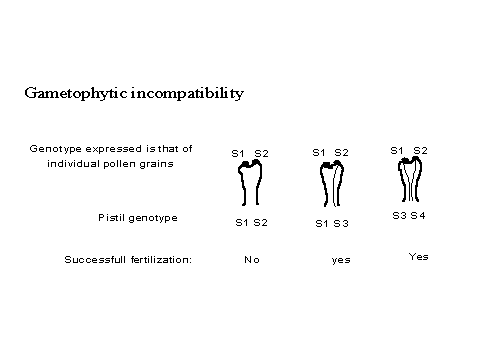
Gametophytic self-incompatibility
Self-incompatibility
is a genetic mechanism in flowering plants that prevents self-fertilisation,
by enabling the pistil to reject pollen from genetically related
individuals, and is controlled by multi-allelic S-loci
(de Nettancourt 1977; Incompatibility in
Angiosperms, Springer-Verlag: Berlin). In gametophytic self-incompatibility systems that
have a single S-locus, identity
of the allele occurring in a pollen grain with either of the alleles in a
recipient pistil is sufficient to prevent fertilisation. Molecular studies
of the pistil incompatibility locus in three plant families, Solanaceae,
Rosaceae and Scrophulariaceae, have shown that the pistil S-proteins are members of a class of extracellular basic
glycoproteins with ribonuclease activity, the S-RNases (reviewed by Kao & McCubbin 1996; Proc Natl Acad Sci USA 93:12059-12065;
1997;Plant Physiol Biochem 35:171-176; Sassa et
al. 1996; Mol Gen Genet
250:547-557; Xue et al. 1996; Plant Cell
8: 805-814
S-alleles determining rare specificities have a reproductive advantage
over alleles for common incompatibility types, and many different alleles
are expected to be maintained at approximately equal frequencies for long
periods of time, even in finite populations (Vekemans and Slatkin 1994; Genetics 137:1157-1165; Clark 1996; Plant
Species Biol 11:13-21). Very high levels of amino acid and silent site polymorphism
are thus expected, and are observed, at the S-locus (Clark 1993;
Mechanisms
of molecular evolution,
Sinauer Associates: Suanderland, pp. 79-108).
The
S-locus region(s) determining specificity are still unknown. It is
also unknown whether many amino acid sites or just a few sites are
involved in specificity determination. Until recently, the gametophytic self-incompatibility locus was
thought to recombine rarely, or not at all (Clark 1993; Mechanisms
of molecular evolution,
Sinauer Associates: Suanderland,
pp. 79-108). Thus mutation
alone has been inferred to be the source of new S-allele specificities.
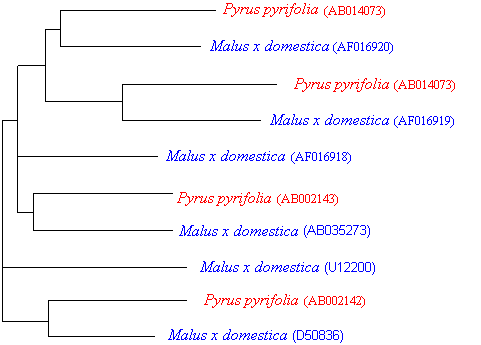
Recently, however, evidence for recombination at the S-locus has been
uncovered both for the sporophytic (Awadalla
and Charlesworth 1999; Genetics 152:413-425
We are currently exploring these and other related issues using as a model system the genus Prunus (Rosaceae).
Researchers involved in this project:
Collaborators:
Deborah Charlesworth