


PORTO IN A GLANCE
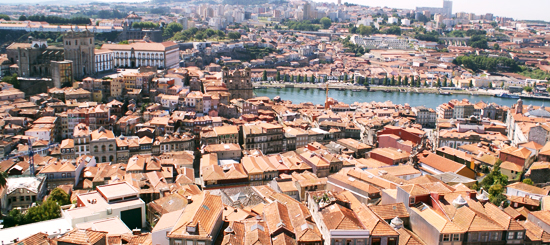
In the northwest of Portugal, built along hillsides and facing the Douro river, one can find the Porto city, an historical witness of the Europe formation. In fact, and with an history of over 2000 years, Porto is one of the oldest European cities. Known as “very noble, always loyal and invict” City, Porto was founded by the romans c. 200 b.C. and initially named Portus Cale, a name that survived through the years and ended up by originating the country’s name itself.
In December of 1996, Porto was acknowledged as World Cultural Heritage, by UNESCO. Among the many reasons that make this beautiful city known across the planet are its beautiful museums (e.g. the Serralves Museum), its incredible monuments (e.g. the Clérigos tower, the old Science’s Faculty, the S. João National Theater), its ancient but still functional traditional markets (e.g. Bolhão market and Vandoma fair) and its lovely romantic gardens (e.g. the Botanical Garden and the Rosa Mota pavilion Garden). The Porto wine, a strong and sweet wine that has the particularity of having a short fermentation time, became known in the second half of the XVII century and is another Ex Libris of the city. More recently (2001), Porto was designated the Capital of Culture, and a new House of Music, designed by the dutch architect Rem Koolhaas, was born in the very heart of Porto.
Porto also holds a key position in the national and international sportive world. The many bridges that cross the Douro river and connect Porto to Gaia were the chosen scenery for the Red Bull Air Races for three years in a row (2007, 2008 and 2009). The gold-medal awarded marathoner Rosa Mota was born and raised in Porto. And, last but not least, in the east side of town one can find the beautiful and glorious Dragon Stadium. Home of the Futebol Clube do Porto, the best-known Porto football (soccer) club, the stadium was designed by the architect Manuel Salgado for the European Football Championship that took place in Portugal, 2004, and has 50399 seats. Futebol Clube do Porto is a worldwide famous football club, with an enviable list of trophies: 2 Champions League cups, 1 UEFA cup, 2 Intercontinental cups, 1 European Supercup and numerous victories in national competitions.
Porto people are known to be down-to-earth, quite stubborn, very authentic and hard-working. A curious legend that has survived through the centuries depicts well the character of this people: it is said that in 1415, when the Portuguese Armada left to conquer Ceuta, people from Porto made the sacrifice of offering their crusaders all the available meat. Left with nothing but the guts and bowels to cook, and in order not to starve, the people invented a very nutritive and strong in flavor dish that is still nowadays one of the city’s most traditional meals: tripas à moda do Porto (Porto stewed guts with beans).
Acclaimed by many songwriters and poets, Porto is a city of an unique beauty, filled with a distinctive light, an exquisite architecture and singular tastes. Be very welcome to Porto and please, do enjoy your stay.
LINKS TO TOURISM
To find more information about Porto, please visit:
Porto tourism official website: http://www.portoturismo.pt/
Porto XXI website - http://www.portoxxi.com/index.php?ss_idioma=en
Municipal Council of Porto International Website - http://english.cm-porto.pt/index.php
GALLERY
http://www.portoxxi.com/album/
Rua do Campo Alegre, 823, 4150-180 Porto - Portugal
Tel +351 226 074 900 . Fax +351 226 099 157 . Email: info@ibmc.up.pt